European Mountains and Rivers Day 24 – Maastricht

We made it early into Maastricht this morning so rather than wait for our guided walking tour, Jeanette and I set off, map in hand, to explore this beautiful city. It was Saturday and the locals were out enjoying themselves. The thing that strikes you about this city is how clean it is and how well dressed the locals are.

We checked out the beautiful Basilica of Our Lady. It was immaculately kept and a service was in progress. We headed on through the squares past the town hall and came upon this 13th century church, allegedly the 5th oldest in Holland. When Napoleon came he turned it into a stable. It never got back to being a church and was until recently used as a bike park. It is now the Selexyz Dominicanen Bookstore.

We lunched along the side of the square where Andre Rieu holds his famous concerts. The proprietor was already taking table bookings for the next one. Unfortunately, today the square was packed with garish carnival rides.

Heading on, we checked out the rather magnificent St Serviatus Basicillica. St Serviatus is the patron saint of the city. He was born in Armenia and had a vision which brought him to Maastricht where he unfortunately passed away shortly after arriving and I am talking “shortly” as in around a week or so. So he didn’t actually do anything here. How he got the gig here as patron saint kind of escapes me.

Our walk then took us to a 13th century monastery and Gothic church which has also been converted, this time to a luxury hotel. The doorman kindly let us have a look inside. It was a very impressive conversion.

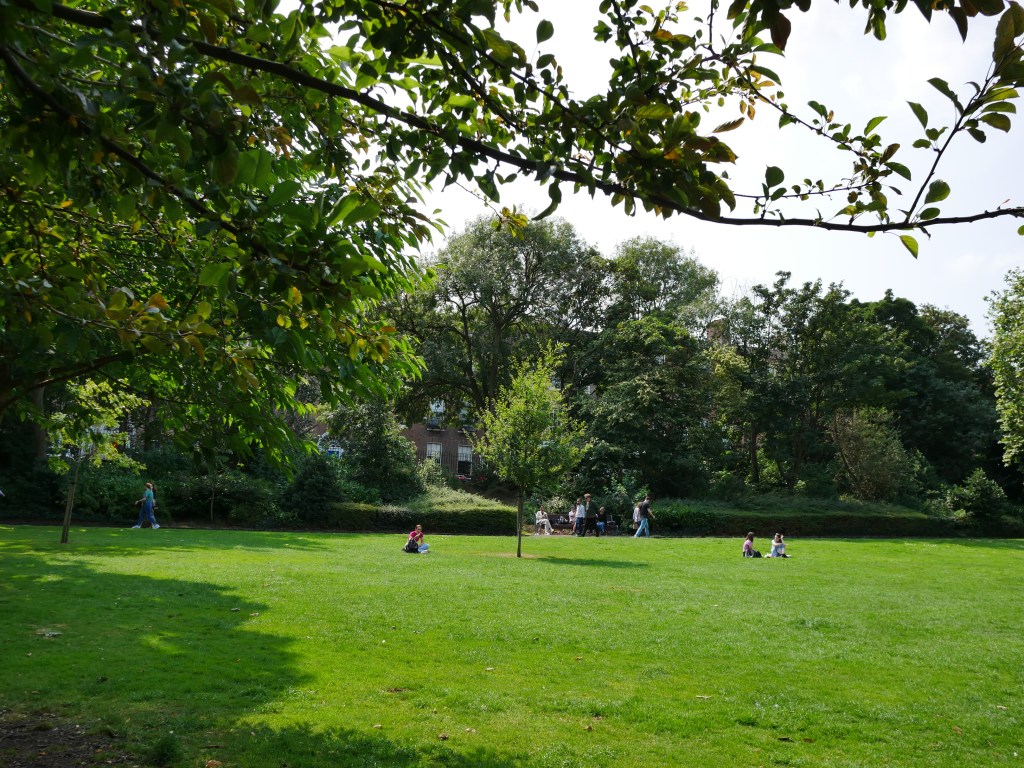
Having now walked over 10km according to my watch, we were starting to flag a bit and headed back to the boat via some pretty parkland that followed the route of the old city wall. Iron woman Jeanette then headed back out to hit the shops while her worn out husband recovered in our cabin.

We really liked Maastricht and can throughly recommend a visit here.

European Mountains and Rivers Day 23- Xanten

Today we tied up in the industrial town of Duisburg and took a bus trip to the town of Xanten. Xanten is famous for a few things. One of Henry XIII’s wives, Anne of Cleves came from hereabouts. It is the only German town with a name starting with an “X” and there was a large Roman town here.

They have taken the site of the Roman town and built some (in my opinion not very convincing) replicas of Roman buildings. To show how big it was they have laid out paths where the roads would have been and our guide took us to the middle of an exposed field and started talking and talking and talking and talking and an icy wind was blowing and everyone was freezing.

Eventually she stopped and we had a look inside their replica buildings. The only mildly convincing one was the colosseum. The reality here was that all Roman relics worth seeing had been removed from this site by the Middle Ages and all they have left are some building foundations and a couple of Roman drains.

Eventually we left the Roman park and headed for the town. At last, I thought, we can get into the town and out of the freezing wind but no. We stopped outside at a map of the town and the icy wind blew and the guide talked and talked.

Finally we got into the town. A pretty enough place. One of the gates in the town walls survives.

An enterprising chap had converted one of the remaining town wall towers into a windmill which was working away grinding wheat.

Eventually we escaped into a coffee shop and sat in the warmth till it was time to return to the buses.


European Mountains and Rivers Day 22 – Koblenz

After a nice slow start to the day, we docked at Koblenz, which is a town located at the so called German Corner where the Moselle River joins the Rhine. The very point of the German corner is marked by a truly massive statue of the first emperor of the United Germany, Kaiser Wilhelm. You can get an idea of its size from the guy sitting halfway up it. This version is a replica. The original of this statue was destroyed by American troops who shelled it till it collapsed.

On the other side of the Rhine is a massive fortress which was built in the 19th Century. This current fortress replaced the earlier one which was destroyed by Napoleon.

Koblenz tends to be a bit short on historical buildings, the town having been comprehensively destroyed by Louis XIV, Napoleon and the Allies. Our guide here was a delightful American lady who on her first visit to Europe sat next to a local winemaker on a flight, wound up marrying him and has lived here for the last 35 years. She had a real passion for the town and delighted showing us its special places.

They have a local hero here called the Robbing Knight. Back in the 15th Century he would prowl the local countryside stealing from the rich and giving to the poor. Sounds familiar but this story has a different ending. He was finally caught and tried in Koblenz and sentenced to death. As he was about to be executed in the town square, he addressed the citizens and told them if they erected a monument to him, the town would have good luck. The towns folk all laughed at this suggestion and  the knight reportedly rolled his eyes and poked his tongue out as they chopped off his head.

I don’t know what it is about German folk tales. To me they never seem to have a satisfactory conclusion. Anyhow the Robbing Knight is remembered around the town on a number buildings, including this clock, where he rolls his eyes and pokes his tongue out every 15 minutes.

They have a great cable car here and we took it across the river and looked at the views over the valley and the town. You can see the German corner in this one.

European Mountains and Rivers Day 21 – Luxembourg

This morning we left our boat tied up safely on the banks of the Moselle River outside Bernkastel and hopped a bus for the one and a half hour drive to Luxembourg.

On an admittedly short acquaintance, I have to say that I think I have found a city that is even more boring than Canberra. Even the graffiti here is contrived and bland.

But we are on holidays and one must make an effort. So here is their Supreme Court building. Jeanette quite liked the vases.

if you look over a rail at the edge of the square here there is an attractive view of the valley.

And I did  like the story of this WW1 memorial. When the Germans occupied the city in WW2 they knocked it over. The golden lady broke into three pieces as it fell but during the night some patriotic chaps rescued the three pieces and buried them for safe keeping. However by the time the war was over they had forgotten where they had buried them and subsequent searches failed to find them. In January 1980 they were rebuilding the main stand of their football stadium and found the missing pieces buried under a row of seats. So the golden lady is now back where she belongs.

On the way back to the boat, we stopped for this magnificent view over the Moselle valley.

Back at the boat we headed out for a walk through Bernkastel. This is a real gem of a place with 15th and 16th Century buildings everywhere you look. The sun was shining, the people were drinking beer and coffee in the outdoor cafes and some  of the shop keepers were out enjoying the sun and chatting to the locals.
 

European Mountains and Rivers Day 20 – Down the Moselle to Bernkastel

Today was a scenic cruising day down the beautiful Moselle valley with its impossibly steep vineyards covering both banks.

For Jeanette, the enforced inactivity of scenic cruising was getting  to her and she was starting to pace the deck.

Fortunately we had to stop around 3pm as 20 intrepid passengers were going to ride the next 25 km on the ship’s bikes and meet up with us at our overnight destination.

As we had about a 45 minute stop, we jumped off and had a walk along the beautiful river bank. We came across a mother goose with her little brood. She was keeping them well in line while dad was off chatting with a nearby swan.

By the time we came back down the path dad and the kids had all settled down for an afternoon nap and mum was keeping watch.

Further down the river, we passed under the  Hochmoseluebergang Bridge. This massive structure  carrying 4 lanes spans the valley from side to side. It is some 158 meters high and 1.7 kms in length. It is nearing completion and is designed to facilitate trade between Belgium and Germany. You will note from this photo that our top deck has been reduced to minimum height as the river is running some 1 metre above its normal level and we have to squeeze under some of the bridges: just not this one though.

Here is a shot of us entering our last lock for the day.

And here is the lock gate going down into the water to let us out. Just beyond this lock the river narrows a bit and there is not enough room at our destination town of Bernkastel to turn around so the captain sailed the ship backwards for the next 2 kms.


European Mountains and Rivers Day 19 – The Moselle River to Cochem

We have left the Rhine and are now travelling up the beautiful Moselle River to the town of Cochem. The thing you first notice when approaching this town is the Castle towering over it.

And if there is one thing that Jeanette likes almost as much as visiting churches, it’s visiting Castles. So this was our first order of business. There were some fabulous views of the surrounding countryside from up on its walls.
There has been a castle on this spot since at least 1000AD. The current one however was  built in the 19th Century by a German Industralist as a summer residence. Its predecessor had been blown up by Louis XIV’s troops. This particular French king seems to have wrought havoc over large areas of this region.

Now if you were asked what particular animal this statue represented I am guessing you would say a frog. But you would be wrong. It’s a lion wearing a helmet with the visor closed. The lion was the symbol of the counts that used to rule this region.  But as to why it’s wearing a helmet is a little unclear. I reckon it’s because the sculpter couldn’t do lion heads.

The town below is very quaint and full of houses from the 17th century. It still has significant portions of its town wall and a couple of the town gates still intact.

Tonight we had dinner at the Portobello restaurant on the boat. We had arranged a table of 10 comprising friends we has made on the Swiss section of our tour. It was a very enjoyable night.

European Mountains and Rivers Day 18- Rudesheim and the Rhine Gorge

This morning we are in Rudesheim. As we had visited this town before, we skipped the organized tour, had a leisurely start to our day, then walked down to the town on our own.

While we are moored opposite a lovely park, the town is unfortunately cut off  from the river by the railway.

Still its back streets and alleys are very picturesque.

To celebrate Mother’s Day, I shouted Jeanette a Rudesheim coffee. Making these is a rather involved process and the waitress arrived at our table with all the ingredients including little 40ml bottles of brandy which had been preheated in a special oven behind the bar.

She poured the  brandy on the sugar cubes and set it alight. After some vigorous stirring, she added the coffee then put a great lump of whipped cream on the top. It did taste rather nice.

Back on the boat we set off around 2pm for our transit of the Rhine Gorge. This very beautiful stretch of the river has some 40 castles built along it.

We started out up on the top deck, but although the sun was shining, the wind was icy cold and we were soon driven back to the shelter of our cabin.

Still the river twists and turns so much in this part, I don’t think we missed very much

European Mountains and Rivers Day 17 – Heidelberg

We docked this morning in the industrial river port of Mannheim. The wharf here was so high we climbed up to the roof of our boat and walked straight off.

We took a bus to the university city of Heidelberg. Our first stop was at Heidelberg Castle.  This was blown up during Louis XIV’s second and this time successful assault on the city. His first had failed some five years before and this time he came back and leveled the city.

The inhabitants started to rebuild the castle but after the building works were struck twice by lightning they took it as a sign that God did not want it rebuilt and left it. So today you have a mix of restored bits and ruins. Its unusual appearance is further enhanced by the practice of successive ruling Counts to build their own palace within the fortress walls while leaving the earlier palaces in existence.

Some of the unrestored structures are quite magnificent.

In the cellar of one of the palaces, you can find what is claimed to be the world’s largest wine barrel. You can get an idea of its size from the people in the photo.

Up on the castle walls you can get a great view over the town.

After the castle, we headed down to the city. Jeanette found a local who helped us with directions.

One bit of local colour we struck was a candidate canvassing for votes for the coming EU elections. I am not sure what his platform was but he was winning the crowd with free pizza handed out by a singing pizza man.

European Mountains and Rivers Day 16 – Strasbourg

We arrived this morning in the German town of Kehl where we caught a bus for a short trip over a bridge and into the Alsace region of France and the town of Strasbourg. There cannot be many places in the world where you can catch a tram from one country to another  but you can here.

Our guide told us that her grandmother’s nationality had changed four times during her lifetime and she had never moved house. Of her two sons, one had wound up fighting on the German side in WW2, the other for the French. It is perhaps appropriate then that this city was chosen to house the EU parliament and courts.

The road into the city was lined with plane trees, each supporting a stork’s nest, most with a stork in residence.

it is an incredibly beautiful city, crisscrossed with running rivers and streams.

Most places you will find the odd occasional cute medieval lane. Here they were everywhere. Every corner you turned was another amazing vista.

The Church was an impressive medieval construction with stained glass dating from the 13th  Century.

Here we are having a coffee as the world streams past.

European Mountains and Rivers Day 15 – A walk in the Black Forest

Around 7:30 am we tied up in the town of Breisach. We had planned to go on the Black Forest hiking tour but it was pouring rain so we piked and chose to go to the open air museum at Vogtsbauernhof.

After an interesting drive through parts of the Black Forrest we arrived at the museum. This was a collection of 15th to 17th Century farm buildings most of which had been moved to the site.

There was one magnificent example that was original to this site. The farmhouses here were huge with barns on the lowest level for the cattle; living area for the farmer, his wife, children and servants on the second level, and a huge food storage area on the top level.

An amazing feature of the building was it did not have any chimneys. In the kitchen area, the smoke was so thick they used to smoke meat up in the rafters. As you could imagine, working daily in conditions like this, the female life span was in the region of 35 years.

I was rather taken by this early fridge for keeping the milk cool. Carved out of stone it had a stream running through the base.

We then had a demonstration of how a Black Forest Cake was made then tried  a sample.